10/31/13
In Class:
Journal-- Reflect on a conflict in your life (past or present). What forces are at odds?
Reviewed and discussed "Judith."
- Biblical stories adapted as Old English poetry were often re-shaped to present a similar story with themes and ideals to which Anglo-Saxons could better relate. Details, language, and underlying themes could be modified by poets to reflect more specific goals and, of course, to close the gap between Germanic heroic tradition and Christianity.
Noted three crucial aspects of Old English poetry, particularly Beowulf:
oral tradition: the practice of verbal storytelling as a means to preserve culture.
- Oral poetry is, by nature, bound to change. The poets would intentionally alter the words and story to appeal to a different audience or create a different message. The poets would also unintentionally modify the stories: consider a game of 'telephone' in which words and ideas can be distorted, modified, or changed entirely. Additionally, since these poets would memorize thousands of lines, they would inevitably make mistakes.
- Beowulf was composed several hundred years before being transcribed; even then, it is theorized that at least two poets contributed to the transcription. Therefore, the Anglo-Saxon community modified and re-shaped the story over the course of several hundred years, making it more powerful and relevant to them.
alliteration: the repetition of initial consonant sounds.
- The use of frequent alliteration helped poets memorize the epics. Most extant poetry from the Anglo-Saxon era uses alliterative verse.
- Due to the common use of alliteration, we can see very interesting names attributed to characters in order to fill out alliteration. Rarely is Beowulf referred to as just "Beowulf," but also as "son of Ecgtheow," "the Geats' lord," "Hygelac's kinsman," etc.
appositive style: the practice of using common descriptive phrases to rename the subject of the sentence. E.g., Chase, the mighty Anglo-Saxon Lit. student, driver of Jeeps, did his homework.
- This style is very common in Old English poetry, as well. It helps the poets create stronger meter and alliteration, which is again helpful for memorization. The strange sentence syntax it creates (see example sentence above) is typical of ancient Germanic poetics.
Distributed Beowulf and first reading assignment -- line 210 by Monday.
Exit ticket: Write a sentence that uses at least two instances of alliteration.
Homework:
Read through l. 210 of Beowulf by Monday.
Catch up on any missing work.
Friday, November 1, 2013

Wednesday, October 30, 2013
October 30th, 2013
10/30/13
In Class:
Journal-- How do your daily choices (of behavior, speech, etc.) affect the lives of others? Use examples to illustrate your point.
Each group from yesterday's research project polished and then presented their posters.
Brief lecture and discussion on "The Passion of King Edmund" by Ælfric, including martyrdom and hagiography.
martyr: a person who suffers and/or dies for his or her beliefs or people.
hagiography: the biographical writing of a saint's life, miracles, or passion.
In the medieval period in Anglo-Saxon period, most of the power of literacy fell in the hands of Christian monks. This resulted in a) the proliferation of religious texts (especially saints' lives), and b) the increased evolution and incorporation of Latinate and French language (i.e., Anglo-Norman dialect).
Hagiography helps us, once again, to reconcile the active, heroic traditions of Germanic culture with passive, virtuous traditions of Christianity.
Exit ticket: Name one martyr other than King Edmund.
Homework:
Read "Judith."
Tuesday, October 29, 2013
October 29th, 2013
10/29/13
In Class:
Journal-- Free-write using the following quote as a jumping-off point:
"Be brave. Take risks. Nothing can substitute for experience." -Paulo Coehlo
Note: for those students who want to improve their quiz scores, there will be an after-school review session and project which will replace your quiz grade on Wednesday and/or Friday.
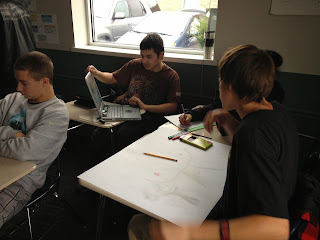
In groups of three, students researched either Norse or Anglo-Saxon polytheistic religious practices, considering the following points to guide research:
- Creation story
- Religious symbols
- Common practices and rituals
- Primary gods/dieties
- Similar/related religions
- Important places/locations
Exit ticket: Name one cool thing you've learned in the last week (whether or not it was in this class).
Homework:
Read "The Passion of St. Edmund, King and Martyr."
In Class:
Journal-- Free-write using the following quote as a jumping-off point:
"Be brave. Take risks. Nothing can substitute for experience." -Paulo Coehlo
Note: for those students who want to improve their quiz scores, there will be an after-school review session and project which will replace your quiz grade on Wednesday and/or Friday.

In groups of three, students researched either Norse or Anglo-Saxon polytheistic religious practices, considering the following points to guide research:
- Creation story
- Religious symbols
- Common practices and rituals
- Primary gods/dieties
- Similar/related religions
- Important places/locations
Exit ticket: Name one cool thing you've learned in the last week (whether or not it was in this class).
Homework:
Read "The Passion of St. Edmund, King and Martyr."
October 28th, 2013
10/28/13
In Class:
Journal-- For what or whom would you fight to the death? Why?
Brief review quiz on material from Week One.
Distributed missing work reports. Please let me know if you think your grade or missing work report is inaccurate.
Reviewed "Bede's Account of the Conversion of King Edwin," specifically focusing on the sparrow conceit and the complexity of the king-thane relationship.
metaphor: a poetic or figurative comparison of two unlike things.
conceit: an extended metaphor (e.g., banking in Martin Luther King, Jr.'s "I Have a Dream" speech)
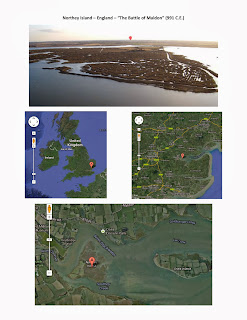
Read and discussed "The Battle of Maldon" including background information on Northey Island, the likely location of this event. (See right)
Read and listened to Byrhtnoth's formal challenge in Old English, then discussed the concept and practice of "words vs. deeds" in Anglo-Saxon England.
Exit ticket: Describe Germanic heroic tradition.
Homework:
Make a creative/artistic depiction of the concept of "words and deeds."
Catch up on any missing work.
In Class:
Journal-- For what or whom would you fight to the death? Why?
Brief review quiz on material from Week One.
Distributed missing work reports. Please let me know if you think your grade or missing work report is inaccurate.
Reviewed "Bede's Account of the Conversion of King Edwin," specifically focusing on the sparrow conceit and the complexity of the king-thane relationship.
metaphor: a poetic or figurative comparison of two unlike things.
conceit: an extended metaphor (e.g., banking in Martin Luther King, Jr.'s "I Have a Dream" speech)

Read and discussed "The Battle of Maldon" including background information on Northey Island, the likely location of this event. (See right)
Read and listened to Byrhtnoth's formal challenge in Old English, then discussed the concept and practice of "words vs. deeds" in Anglo-Saxon England.
Exit ticket: Describe Germanic heroic tradition.
Homework:
Make a creative/artistic depiction of the concept of "words and deeds."
Catch up on any missing work.
Friday, October 25, 2013
October 24th, 2013
10/24/13
In Class:
Journal-- What role has religion played in your life? How do you define your religious beliefs? How did you develop those beliefs?
Reminder about the field trip to All the Great Books (abridged).
Reviewed guilt- and shame-based societies.
Reviewed and discussed "The Dream of the Rood": above all else, this poem exemplifies the reconciliation of the Germanic heroic tradition (active) with the burgeoning Christian faith (passive) by portraying Christ as an active, courageous, and heroic figure (like Beowulf) as opposed to strictly a passive, loving, accepting character. "The Dream of the Rood" creates parallels with tree imagery to the Old Testament of the Bible (Tree of Knowledge) and Norse mythology (Tree of Life). Additionally, it creates a chain reaction dynamic of heroic inspiration through the phrase elne mycle.
Discussed concepts and information from this week for quiz on Monday. Be comfortable with the following subjects:
- The various groups responsible for the development of English [Anglos, Saxons, Jutes, Norse (Vikings), Christian missionaries, and Normans]
- Guilt- and shame-based societies
- Norman Conquest
- Europe map
- elegiac and heroic styles
- definition of language
- king-thane (lord-subject) relationship
- "The Wanderer"
- "The Dream of the Rood"
Exit ticket: What year was the Norman Conquest?
Homework:
Read "Bede's Account of the Conversion of King Edwin."
Study for a quiz.
Catch up on any missing work.
Thursday, October 24, 2013
October 23rd, 2013
10/23/13
In Class:
Journal-- Make a T-chart. On one side, list actions that you consider morally or ethically “good” deeds. On the other, list actions that you consider “bad.”
The school is offering a field trip on Friday night to see All the Great Books (abridged), performed by the Reduced Shakespeare Company. The play is worth extra credit for this class, as it features Beowulf.
Reviewed and discussed "The Wanderer," particularly focusing on:
a) standards of masculinity and individuality,
b) the king-thane relationship, and
c) the role of morality.
"The Wanderer" is a prime example of the Old English elegiac tradition.
elegy: a writing (most often poetry or song) incorporating serious, mournful reflection.
Introduced the concept of Guilt- and Shame-Based societies, including the social construct of morality. Although Anglo-Saxon England is considered part of the Western world, which sort of society does it most closely resemble?
Exit ticket: Define 'elegy.'
Homework:
Write a half-page reflection on a time you felt either shame or guilt for a choice you made. What does your specific feeling say about our social structure?
Read "The Dream of the Rood."
Tuesday, October 22, 2013
October 22nd, 2013
10/22/13
In Class:
Journal-- How do you define your heritage? Where do you come from? Is heritage important?
Continued lecture and discussion on the evolution of the English language:
How does language and its evolution reflect cultural variety?
 Reviewed the Proto-Indo-European Language origin diagram: Where does English originate? To which contemporary languages is English most closely related?
Screened "The History of English in Ten Minutes" from 0:00-2:19 (Ch. 1 & 2), then noted primary important dates and facts:
c. 450 -- Romans (who spoke a form of Latin) were forced out of the British Isles by the Britons
c. 480 -- Germanic tribes (Angles, Saxons, and Jutes) settled in/invaded/colonized Britain
[German influence on English]
c. 500-550 -- Beowulf takes place.
c. 590 -- Missionaries from mainland Europe bring Christianity and associated ideas and language to Britain
[Latin influence on English]
700-1000 -- Frequent Viking invasions
[Norse influence on English]
c. 975 -- Beowulf is transcribed.
1066 -- Norman Conquest of England. The Normans were relocated Vikings who spoke French and followed French cultural ideals. This invasion was very influential because it introduced about 70% of our Modern English vocabulary.
[French influence on English]
Following the Norman Conquest, French and Latinate words were perceived as the language of nobility, wealth, and elegance; meanwhile, English and Germanic words were considered utilitarian, of the commoners and peasants.
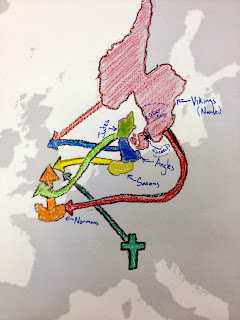 Guided by notes from the instructor, students illustrated their own maps
of linguistic/cultural influence in Britain, similar to the graphic to the left.
Next, each student created a 3 or more panel comic strip illustrating the influence of various invasive cultures as discussed during the lesson today.
Exit Ticket: Name the three Germanic tribes which colonized England.
Homework:
Finish your comic strip.
Read "The Wanderer" and underline at least 5 words you do not recognize.
In Class:
Journal-- How do you define your heritage? Where do you come from? Is heritage important?
Continued lecture and discussion on the evolution of the English language:
How does language and its evolution reflect cultural variety?

Screened "The History of English in Ten Minutes" from 0:00-2:19 (Ch. 1 & 2), then noted primary important dates and facts:
c. 450 -- Romans (who spoke a form of Latin) were forced out of the British Isles by the Britons
c. 480 -- Germanic tribes (Angles, Saxons, and Jutes) settled in/invaded/colonized Britain
[German influence on English]
c. 500-550 -- Beowulf takes place.
c. 590 -- Missionaries from mainland Europe bring Christianity and associated ideas and language to Britain
[Latin influence on English]
700-1000 -- Frequent Viking invasions
[Norse influence on English]
c. 975 -- Beowulf is transcribed.
1066 -- Norman Conquest of England. The Normans were relocated Vikings who spoke French and followed French cultural ideals. This invasion was very influential because it introduced about 70% of our Modern English vocabulary.
[French influence on English]
Following the Norman Conquest, French and Latinate words were perceived as the language of nobility, wealth, and elegance; meanwhile, English and Germanic words were considered utilitarian, of the commoners and peasants.
 Guided by notes from the instructor, students illustrated their own maps
of linguistic/cultural influence in Britain, similar to the graphic to the left.
Next, each student created a 3 or more panel comic strip illustrating the influence of various invasive cultures as discussed during the lesson today.
Exit Ticket: Name the three Germanic tribes which colonized England.
Homework:
Finish your comic strip.
Read "The Wanderer" and underline at least 5 words you do not recognize.
Subscribe to:
Posts (Atom)